
How To Write A Pre-Shipment Inspection Brief For Custom Metal Orders
Your metal order looks ready, but a shipment photo cannot establish which goods an inspector could examine. Define that scope before booking.
Use a written brief to confirm readiness and required evidence. Keep inspection findings separate from your permission to ship.

Define The Private Inspection Task
Use this brief when your buyer appoints someone to examine finished goods before dispatch. It defines what that person should inspect and report. It also identifies which shipment decisions remain with your team.
This is a private order quality task, not a substitute for any applicable customs or government inspection. Do not use it to settle tariff valuation or import permission. Your inspection provider and logistics adviser should clarify any separate requirements.
Decide why attendance at the factory adds value for this order. You might need evidence before a large balance leaves the supplier. Multiple models, unfamiliar packaging or a previous unresolved discrepancy can justify a more specific scope.
QIMA describes finished goods checks tailored to client requirements. These can include specifications, workmanship, dimensions and packaging. Its service thresholds and booking promises are its own, not universal conditions for your order.
Agree the appointment and access arrangements before production reaches the planned inspection stage. Tell the supplier which goods must remain available. Confirm who can open cartons, handle samples and explain the production and packing records.
A booking confirmation does not prove the goods will be ready. Require a readiness update tied to the actual lot shortly before attendance. Keep the decision to proceed, restrict or reschedule with a named buyer contact.
Identify The Lot And Its Boundaries
List every order line and model included in the appointment. Add design revisions, quantities, lot identifiers and carton groups. The inspector needs to distinguish a second model from a color variant of the first.
For custom company logo enamel pins, identify the approved front, reverse and fitting. State whether each backing or package creates a separate check. A correct front photograph cannot identify an incorrect post arrangement.
Separate goods manufactured together from stock merely stored in the same room. Ask how different production lots are labelled and recorded. Combining them under one purchase order does not automatically make them one inspection lot.
Name excluded goods explicitly. An unrelated reorder, an unapproved sample and production for another buyer should not enter your available stock count. Ask the inspector to report unidentified groups rather than guessing their ownership.
If you plan split shipments, show the proposed release groups before inspection. Carton identifiers must support those groups after the inspector leaves. Otherwise, an acceptable report can become detached from the cartons actually dispatched.
Use your agreed sampling plan for the defined lots. Record its source, edition where relevant, inspection level and agreed defect classification. Do not let a generic checklist silently choose those commercial and quality decisions for you.
Confirm Readiness By Model
Ask for separate counts of completed, packed and accessible goods. State what each count means in your order. A production forecast is not a physical readiness count, and packed does not necessarily mean available to inspect.
The supplier should identify unfinished operations and any cartons stored elsewhere. Obtain photographs that show group labels and locations, alongside the written counts. Photographs support readiness planning but do not replace the inspector’s onsite confirmation.
Avoid setting one universal ready percentage for every order. Your agreed provider procedure and inspection purpose determine what must be available. A high overall completion figure can conceal the complete absence of a critical model.
For example, all pins may be ready while the medals still lack ribbons. The combined order percentage hides that distinction. Decide whether inspecting the ready model alone serves a useful, clearly bounded shipment decision.
If you proceed with reduced scope, revise the brief before attendance where possible. Name the remaining goods and the later verification required. Do not leave the inspector to assume that missing units will match those already finished.
Give the appointment a practical cancellation or rescheduling decision point. Agree who confirms readiness and how late restrictions will be escalated. Any attendance charges or repeat visit costs belong in the accepted service arrangement.
Give The Inspector Current References
Send the accepted purchase order, current drawings and approved physical sample instructions together. Identify the controlling revision and document date. Include only references the inspector can reconcile, rather than an unexplained history of email attachments.
Explain how the physical reference will reach the site and how its identity will be checked. A loose sample without an approval reference may be misleading. Identify any feature for which a drawing or measurement takes priority over appearance.
For custom diecast medals, distinguish the required front, reverse, ribbon and attachment. Include the intended orientation of the assembled medal. Use marked features to connect the reference with specific report photographs.
Make the inspection criteria operational. Replace an instruction such as good quality with the agreed condition and comparison reference. Separate a visible difference from the severity and disposition your buyer assigns to it.
If your order lacks an agreed criterion for an important feature, resolve it before asking for a pass decision. The inspector can report an observation. It cannot reliably reconstruct your brand’s acceptable appearance range from a product name.
Keep first article approval separate from this finished lot review. Our medal first article inspection guide addresses that earlier production gate. A passed first article does not establish the condition of every finished shipment.
Turn Order Requirements Into Checks
Group your checks by the question they answer. Identity checks establish whether the goods are the ordered version. Appearance, dimensions, assembly and packaging require their own observations and evidence.
For keychains, an inspector might confirm the specified connector and examine its assembly on selected pieces. Any functional method needs defined conditions and acceptance criteria. Do not request an improvised destructive pull test without an appropriate agreed procedure.
State which measurements are required and identify the features on the drawing. Confirm suitable equipment and access before the appointment. An image of a ruler beside a product may not meet a tolerance verification requirement.
Keep chemical, corrosion and other laboratory evidence on a separate reference line. Ask whether the required report covers the supplied material and batch. Routine onsite inspection should not be represented as laboratory confirmation of an unseen coating property.
RINA lists goods identification, quantity, packaging and document review among inspection duties. Its reference documents include customer orders and technical documentation. Select the tasks relevant to your own private inspection appointment.
Our complete parcel packaging approval guide covers a different decision about transport packaging. An onsite carton review can confirm the approved configuration. It cannot reproduce a transport test merely by looking at the carton.
Fill A Three-Model Inspection Brief
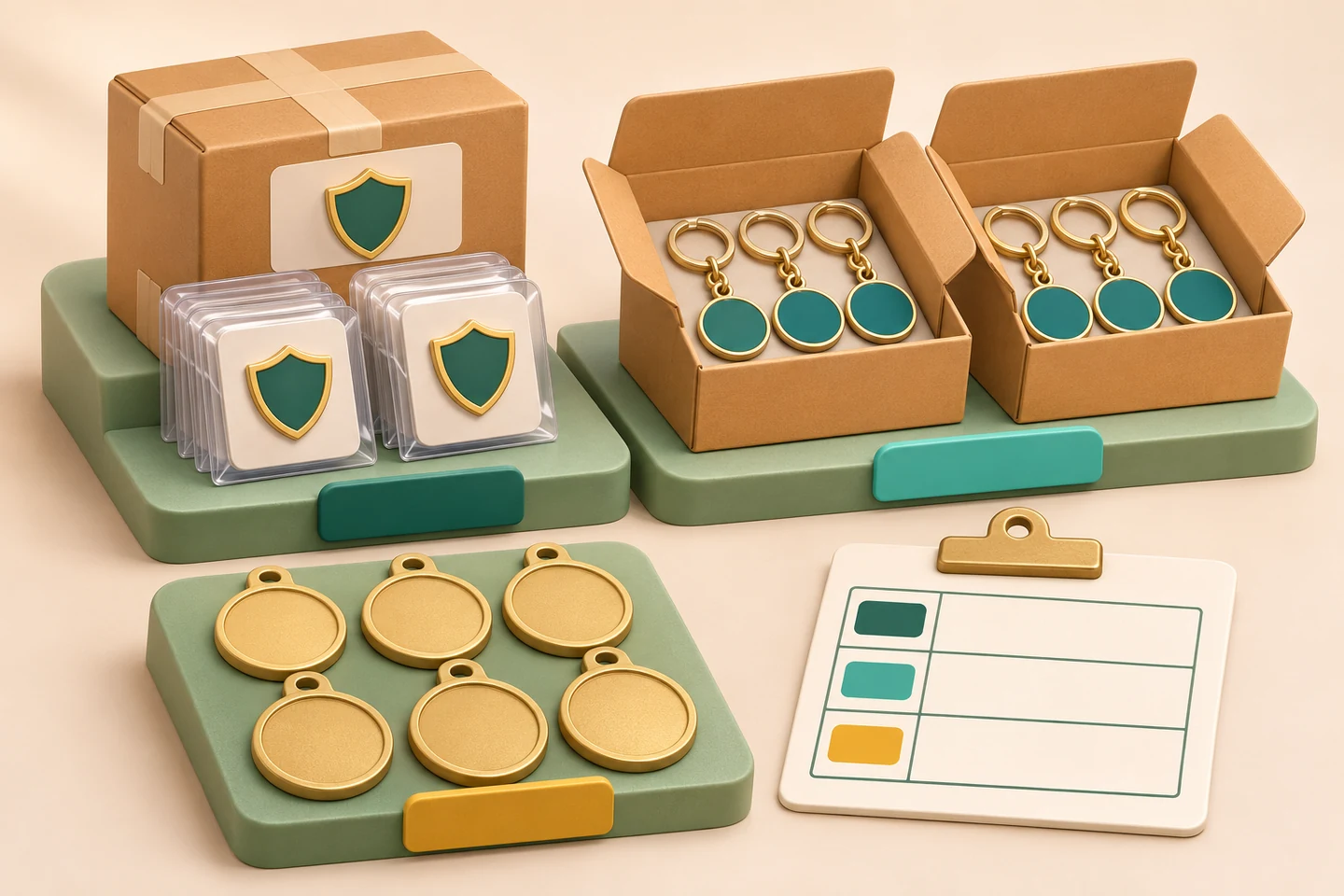
Consider a hypothetical order containing 600 pins, 400 keychains and 300 medals. Each carton holds 100 finished pieces. The planned identifiers are P01–P06, K01–K04 and M01–M03.
The buyer appoints an independent inspector for the finished lots and provides model specific references. The accepted plan governs sampling and defect classification. The quantities below describe lot availability, not the number of pieces physically examined.
On arrival, all 600 pins are accessible. The 400 keychains are finished, but carton K04 cannot be made available. Only 200 medals are finished; the final 100 remain incomplete.
The inspector therefore has access to 1,100 finished pieces across the available groups. That is 600 pins, 300 keychains and 200 medals. The report must preserve these boundaries even if its overall template offers only one result box.
| Brief Field | Filled Illustrative Instruction |
|---|---|
| Order Scope | PO Q-518: P model 600, K model 400, M model 300; current approved revisions attached. |
| Available Groups | Inspect the accessible finished groups; confirm actual readiness before applying the agreed sampling plan. |
| References | Pin PS-12; keychain KS-08; medal MS-05; controlled drawings and approved packing sheets. |
| Required Evidence | Model and lot identification, selected carton IDs, observations, specified measurements and identified photographs. |
| Site Restrictions | Record any inaccessible carton, unfinished group, unavailable reference or unperformed check. |
| Result Routing | Send the complete report to buyer quality lead Alex; supplier explanations remain identifiable. |
| Shipment Authority | Purchasing lead Sam issues a separate release naming cartons; report completion alone does not authorize dispatch. |
Preserve Independent Sample Selection
Tell the supplier to present the agreed lot without preselecting only its best pieces. Give the inspector the access needed for the sampling arrangement. Record when access or selection differs from the approved plan.
An accessible outer carton does not establish access to every unit inside it. Clarify permission to open inner packaging and remove protective material. If repacking is required afterwards, define responsibility and the records needed to preserve identity.
If the supplier offers substitute cartons, ask why the original group is unavailable. Confirm whether the replacement belongs to the same defined lot. Do not silently transfer an inspection result to a carton outside the documented selection frame.
Keep any pieces removed for destructive checks or laboratory work separate in the quantity reconciliation. The shipping count may change. Ask whether replacements enter the same inspected lot or need additional confirmation before release.
A host employee can assist with handling while the inspector records who selected the pieces. Assistance should not obscure sample identity or restrictions. Document any disagreement about access in the report, including the affected models and checks.
Record how opened samples return to their cartons after review. Preserve their lot identity and flag pieces retained or damaged during examination. A correct report should not leave the warehouse unable to reconstruct the finished shipping quantity.
Read The Report For Coverage And Limits
Start with the inspected lot description, not the final result label. Compare it with your brief and the factory readiness statement. Check which models, carton groups and required observations the report actually covers.
Look for omitted tests, missing references and limitations in the narrative and photographs. A pass beside appearance does not resolve an unperformed assembly check. Ask for clarification where the report’s conclusion and its supporting detail conflict.
In the example, K04 remains uninspected and M03 remains unfinished. A later photograph showing those cartons cannot extend the original inspection coverage. Decide the additional evidence or attendance needed before those goods can join a released shipment.
Suppose the medal observations also identify ribbons assembled in the wrong orientation on selected pieces. The buyer holds the medal group for investigation and correction. The supplier must establish the affected range rather than assuming the observed sample count equals the defect total.
Require a corrected report where a factual identity or count was wrong. Preserve the first report and the reason for replacement. A supplier’s private summary should not overwrite the inspector’s observations or conceal an unresolved qualification.
Issue A Bounded Shipment Decision
Separate report review from commercial release. Your buyer may accept, hold, request correction or permit a specifically identified partial shipment. Record the evidence and remaining conditions for the chosen outcome.
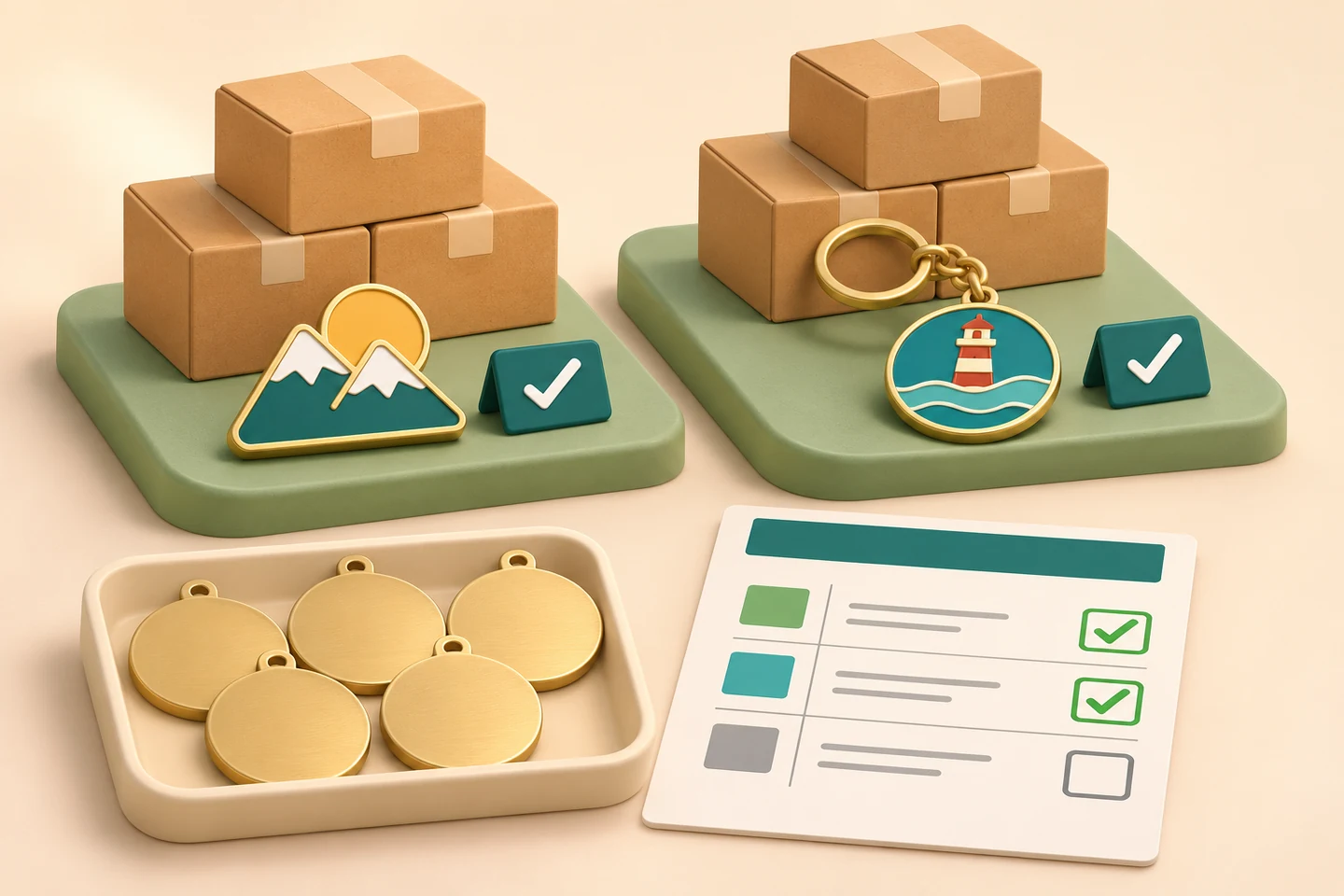
In the example, the pin and accessible keychain groups meet their agreed requirements. Sam authorizes P01–P06 and K01–K03 only. Those nine cartons contain 900 pieces: 600 pins and 300 keychains.
The remaining order balance is 400 pieces. It contains K04 with 100 keychains and all 300 medals. Do not subtract the accessible 200 medals from that balance merely because the inspector saw them.
Keep the held goods physically and administratively separate. Ask the supplier to confirm the release list against its dispatch instructions. Logistics should receive a carton specific instruction rather than an email saying the order passed.
A partial release must also fit the accepted shipping and commercial arrangements. Check the effects on freight, documentation and intended destinations. Do not assume quality permission alone changes a contractual shipment condition.
| Group | Illustrative Buyer Decision |
|---|---|
| P01–P06: 600 Pins | Eligible for shipment after report and other order conditions are satisfied. |
| K01–K03: 300 Keychains | Eligible within the separate written partial release. |
| K04: 100 Keychains | Hold; access and inspection coverage unresolved. |
| M01–M03: 300 Medals | Hold; investigate assembly range, correct affected goods and complete the final carton. |
Before relying on the keychain result, Alex confirms the sampling coverage is valid for the defined 300 piece group. Any missing coverage needs additional checks. The partial release cannot simply borrow an acceptance result calculated for a different lot.
Define Reinspection And Follow The Shipment
Ask for a correction record that identifies the affected stock and the work performed. The record should separate corrected pieces, rejected pieces and any replacements. A closeup of one corrected ribbon does not account for 300 medals.
Define what the next inspection must establish. It may need to verify the corrected feature and confirm previously missing goods. Decide whether other checks remain applicable or must be repeated because the work changed them.
For K04, confirm that the carton is accessible and belongs to the stated keychain lot. Agree the appropriate followup scope with your inspector. Do not treat its late availability as proof that the earlier result covers it.
For the medals, confirm completion of M03 and trace correction across M01–M02. Retain the original observations and the later evidence together. Release the remaining 400 pieces only when their particular open conditions are resolved.
Finally, match the dispatch documents with the written release and actual carton identifiers. Keep inspection records available to receiving. Our receiving inspection guide explains the separate checks after arrival; earlier inspection does not eliminate that handoff.
Frequently Asked Questions
Can The Supplier Choose The Inspection Company?
You can consider its suggestion while retaining control over the appointment and instructions. Confirm who commissions the service and receives the complete report. Disclose relevant relationships and agree independence before booking.
Should The Inspector Attend Container Loading?
Treat loading supervision as a separate service and scope decision. A finished goods inspection does not automatically observe later loading. Specify any seal, carton identity or loading evidence your logistics arrangement requires.
Can We Pay The Balance After An Inspection Pass?
Your accepted payment terms determine when payment is due. Ask purchasing or finance to interpret any inspection condition in that agreement. Do not assume a report changes contractual payment obligations.
Can We Reuse The Report For A Repacked Shipment?
Check whether the later work changes any evidence on which release depended. A different insert, quantity or label may need another check. Preserve the original report and record the additional evidence rather than relabelling it as current.
Final Thoughts
Include your finished goods references and proposed inspection scope when discussing bulk custom logo keychains. Name who reviews the report and who can authorize the identified cartons to ship.