
How To Brief A Nickel Release Test For Metal Clothing Labels
A metal label report may describe a different finish from the label on your garment. That gap can leave your approval unsupported.
Use a clear test brief and coverage sheet. Match the required evidence to the actual sample before deciding what your order can use.

Establish The Requirement For Your Order
Start with the destination market, customer specification and intended clothing use. Identify who within your business can confirm the applicable requirement.
A request for nickel testing needs a defined purpose. Ask whether the buyer needs a release result, material composition information or another document.
These requests answer different questions about the metal. A statement about total nickel content cannot automatically answer a requirement for nickel release.
For EU orders, the official nickel restriction connects garment metal parts with their actual direct and prolonged skin contact. Have your responsible compliance reviewer assess the finished garment and intended use.
An exterior label on a lined coat and an inward-facing collar label can present different contact situations. Do not give both the same instruction without reviewing their positions.
Write the requirement source and reviewer on your purchasing sheet. Keep an unresolved applicability question visible instead of treating the laboratory booking as approval.
When your customer supplies a restricted substances specification, retain its exact revision. Ask which requirement governs if the customer document and test request differ.
You can still prepare product and sample information while that question is resolved. Confirm the test scope before authorizing work that might answer the wrong question.
Map Contact On The Finished Garment
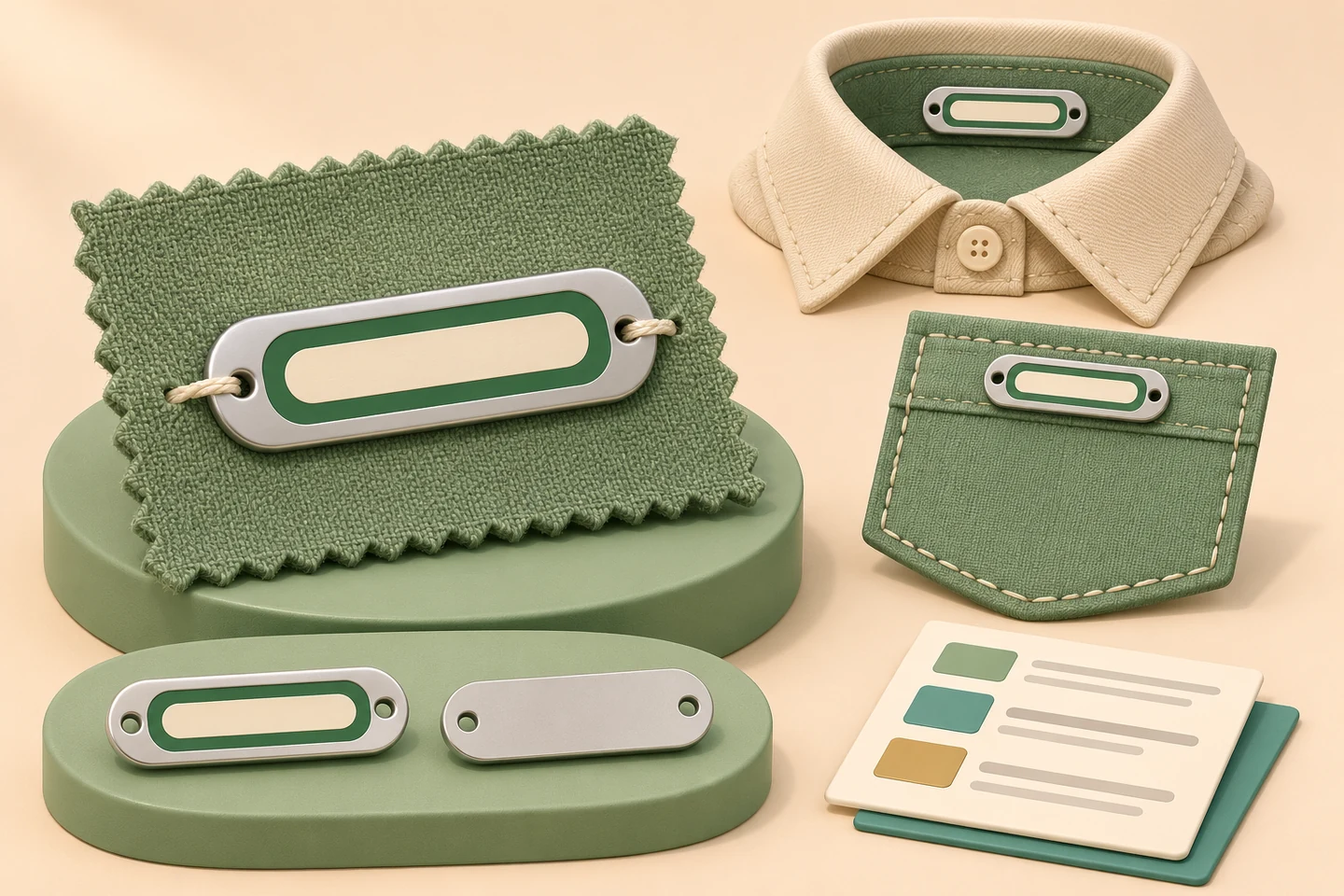
Record the garment style, placement and way the label is attached. Include a photograph from the outside and another showing the fabric behind it.
For custom metal clothing labels, the published reference has a flat reverse and two open sewing holes. Your project still needs its own material, finish and installation confirmation.
Show whether fabric separates the label from the wearer during intended use. Include any exposed edge or reverse surface that your reviewer considers relevant.
Describe the garment as worn rather than only as laid flat. A fold, open fastening or thin lining might change which surface can touch skin.
Do not decide the laboratory sample area from a marketing photograph. Send the placement information and ask how the agreed contact situation affects specimen preparation.
Keep the thread path and hole positions visible in your installation reference. Any masking or disassembly for testing needs the laboratory to explain its purpose.
Make a separate contact entry when the same label moves to another garment position. Approval for one position does not establish the requirement for every future style.
If placement remains undecided, identify the candidate positions individually. The buyer can then choose a position with a clear record of its evidence needs.
Separate The Sample Versions
List every label version you intend to purchase before choosing specimens. Use the actual label code, drawing revision, finish designation and production state.
Two labels can share an outline while having different surface constructions. Ask the supplier to identify differences relevant to the proposed evidence.
Describe the substrate and surface layers as precisely as the supplier can confirm. Keep an unknown layer recorded as unknown until a suitable explanation arrives.
Do not assume a matching colour means a matching layer structure. The plating appearance guide addresses visual approval, which remains a separate decision.
A signed appearance sample can identify the desired face without proving release performance. Keep its sample identity linked to the test specimen where the constructions match.
Group versions only when the laboratory and responsible reviewer accept the technical basis. Ask them to state which differences the selected specimen represents.
A broad description such as metal garment label provides little help when another finish arrives. Add a photograph and precise version references to the sample list.
If your order contains other components, identify them separately. A result for a label plate does not automatically cover a separate zipper, pin or attachment.
Confirm The Laboratory Brief
Give the laboratory your requirement source, contact map and version list together. Ask it to review the intended scope before preparing a quotation.
The BSI publication record identifies BS EN 1811:2023 as the current release. Its title addresses pierced assemblies and articles intended for direct and prolonged skin contact.
The EU standards reference publication separately lists the nickel release method and a coated-item wear and corrosion method. Ask the laboratory which methods and preparation apply to your specific requirement.
Put the proposed method and edition in the written brief. Resolve a mismatch between the customer specification and quotation before specimens are consumed.
Ask whether the finished surface construction requires additional preparation within the agreed assessment. Record who confirms that choice and which specimens it affects.
Specify what the report must identify about samples and tested areas. Request enough specimen description to connect the result with your drawing and submitted photographs.
Ask how the laboratory will describe any preparation that changes the received article. Your reviewer needs that information when assessing whether the evidence represents the supplied label.
Agree the reporting units, assessment basis and person reviewing the conclusion. Have the laboratory explain qualified or unclear results rather than interpreting unfamiliar notation yourself.
Record And Send The Specimens
Assign a specimen reference before removing labels from their production packaging. Record where each specimen came from and which order version it represents.
Photograph the face and reverse beside the specimen reference. Include the sewing holes and any surface feature used to distinguish otherwise similar versions.
Describe whether the pieces are development samples, approved preproduction samples or taken from a finished lot. Keep that status visible when you later review coverage.
Ask the laboratory to confirm specimen quantities for the agreed work. Do not substitute a generic sample count for its requirements or consume your only approved reference unexpectedly.
Retain a suitable identified comparison piece when the agreed sampling arrangement allows it. Record whether that piece actually shares the tested construction and production source.
Avoid polishing, refinishing or cleaning specimens just to improve their appearance before dispatch. Ask the laboratory how specimens should be handled and document any preparation already performed.
Send the specimen list with the parts and retain the dispatch reference. Request confirmation if the laboratory receives fewer pieces or cannot distinguish their identifiers.
A photograph can show what you intended to send but cannot fix an unidentified specimen. Resolve identity questions before testing continues when the result depends on that distinction.
Read The Report Against The Brief
Read the specimen description before reading the conclusion. Check the label code, photographs, finish and received quantity against your submitted list.
Confirm the report describes the method and preparation agreed in the brief. Refer any unexplained change back to the laboratory and your responsible reviewer.
Compare the reported sample area or tested surfaces with the agreed contact map. Ask for an explanation when the report cannot show which surface produced the result.
Keep individual specimens distinguishable where results are reported separately. An overall statement can hide which submitted version the laboratory actually assessed.
Read the result, units and conclusion together with any qualifications. Ask the laboratory what additional information your buyer needs when the stated outcome remains conditional.
Check whether the result is being applied to a sample, a named version or a production lot. Require a documented basis before broadening that coverage.
A sample result does not itself demonstrate that every future shipment has unchanged construction. Link any purchasing decision to the version, source and production evidence you actually reviewed.
Keep visual and mechanical acceptance records separate from this report review. A label may still need its appearance and mounted garment sample approved before purchasing can proceed.
Work Through A Two-Finish Example
Consider a hypothetical clothing buyer ordering label L24 for two workwear styles. The example illustrates document decisions and does not describe a customer or tested GFS product.
Style C uses finish F1 inside a collar, while style J uses finish F2 on a lined exterior pocket. Both drawings show the same rounded outline and two sewing holes.
The buyer supplies each placement photograph and its customer requirement to the responsible reviewer. That review determines the evidence requested for each intended use.
The laboratory receives specimens S1 and S2 labelled as F1 development samples. The supplier later proposes using their report for the F2 production shipment too.
The buyer compares the references rather than accepting the shared outline as proof. F2 has a different declared surface route and no accepted representation statement.
The following sheet records what can be decided from those documents. Its statuses are illustrative purchasing entries, not nickel release results.
| Reference | Illustrative Coverage Decision |
|---|---|
| L24 F1 / S1-S2 | Compare the report with the agreed F1 brief and specimen photographs. |
| Style C collar | Retain the reviewer decision defining the required contact assessment. |
| L24 F2 production | Not represented merely because its outline matches F1. Request a technical coverage decision. |
| Style J pocket | Review its actual contact situation separately from the collar installation. |
| Development sample status | Record the gap between submitted development specimens and the proposed finished production construction. |
| Order instruction | Keep the unsupported version pending while obtaining the missing evidence or an accepted alternative. |
Suppose the laboratory confirms that its work only describes the submitted F1 specimens. The buyer then asks what evidence would address the proposed F2 construction.
That response might require additional specimens or a different documented scope. The buyer records the agreed next action instead of relabelling the F1 report as universal approval.
If the supplier confirms F1 production has also changed, reopen that version. The original sample identity remains accurate, but its relevance to the new shipment needs review.
Complete The Specimen Coverage Matrix
Continue the hypothetical example with a completed F1 review. The buyer requests fresh specimens S3 and S4 from identified production lot P14.
The laboratory confirms the received identity, agreed method and preparation in illustrative report EX-R18. Its conclusion meets the criterion specified in the hypothetical customer requirement QR-C7.
These report references and outcomes illustrate paperwork decisions only. They are not real laboratory results or evidence about any GFS product.
The responsible reviewer checks that the report describes L24 drawing D, finish F1 and the agreed assessed surfaces. Supplier records connect S3 and S4 to P14.
The reviewer also confirms QR-C7 applies to the intended style C collar use. Those checks complete the document review for the named F1 order line.
Add a separate row for F2 rather than copying that conclusion. The same table can show a completed F1 decision and an unresolved F2 request.
| Example Entry | Completed Review Or Explicit Exclusion |
|---|---|
| Rule QR-C7 | Reviewer confirms the specified release requirement applies to style C collar; contact map C-01 retained. |
| PO EX-24 / line 10 | 800 labels, L24 drawing D, F1, production lot P14, for style C. |
| Specimens S3 and S4 | Received identities and supplier production records match the F1 P14 pieces. |
| Illustrative report EX-R18 | Lists S3/S4 and agreed assessed surfaces; laboratory confirms method and preparation match the brief. |
| Reviewer record RV-04 | Checks report conclusion against QR-C7 and accepts the evidence for the specified F1 P14 order line. |
| F1 purchasing action | Document requirement complete for 800 F1 labels; other physical and order acceptance checks still apply. |
| PO EX-24 / line 20 | 400 F2 labels for style J remain outside EX-R18; surface route differs and coverage is unresolved. |
| F2 purchasing action | Keep line 20 pending the contact requirement decision and suitable evidence; do not reuse RV-04. |
The recorded quantities account for all 1,200 labels without extending the F1 evidence to F2. They also prevent receiving from treating the complete purchase order as chemically approved.
If a report photograph shows the correct face but an unfamiliar reverse, stop the document comparison. Ask the laboratory to check its received-specimen records before correcting any description.
A corrected description may resolve a recording error, but it cannot change which physical piece was tested. Keep the explanation with the revised report.
If the supplier combines F1 and F2 under one packing description, request separate version identifiers before accepting that arrangement. Otherwise receiving cannot apply the matrix to the arriving labels.
Issue The Order Evidence Sheet
Turn the reviewed information into a short instruction that purchasing and receiving can use. Identify the report and the exact order lines it supports.
Keep a separate entry for versions waiting on evidence or an applicability decision. A blank cell should not look like an accepted version to the packing team.
| Field | What To Enter Before Approval |
|---|---|
| Rule | Destination, customer document revision and responsible reviewer. |
| Intended use | Garment style, location and agreed contact description. |
| Product identity | Label code, drawing, substrate and surface version. |
| Specimens | Sample references, photographs and development or production status. |
| Test scope | Laboratory, method edition, preparation and assessed surfaces. |
| Evidence | Report reference, results, qualifications and reviewer response. |
| Coverage | Included versions and explicit exclusions. |
| Order action | Named decision, outstanding work and affected order lines. |
Ask the supplier to confirm it can keep the approved version identifiable through packing. Match the shipping description with the product references used in your evidence sheet.
Tell receiving which label versions require the sheet before acceptance. Do not ask warehouse staff to make a chemical assessment from the colour or supplier stamp.
Define what changes should return to the responsible reviewer. Examples include a different surface route, changed substrate, new production source or another garment position.
Keep revised evidence alongside the original report rather than silently replacing identifiers. Your next buyer should understand which construction each document supports and what changed.
For metal zipper pulls, create their own component and contact entries where relevant. Similar appearance does not make a clothing label report cover a different accessory.
Frequently Asked Questions
Can A Supplier Nickel-Free Statement Replace The Requested Report?
Ask what the statement means and which evidence supports it. If your purchase requirement calls for release testing, confirm any proposed alternative with the responsible reviewer before accepting it.
Should We Put The Test Logo On Our Clothing Packaging?
A laboratory report does not automatically authorize using a laboratory mark or making a certification claim. Confirm the proposed wording and any permission separately before printing packaging.
What If The Customer Sends A Report In Another Language?
Obtain a version your responsible reviewer can assess without losing specimen references or qualifications. Keep the original document and connect any translation to the same report identifier.
Can We Use A Report Supplied By A Previous Garment Factory?
Check who supplied the tested labels and whether their construction matches your proposed order. Obtain a documented coverage decision instead of assuming a factory transfer preserves the evidence.
Final Thoughts
Bring your garment placement, finish references and required documentation when discussing metal clothing labels. Confirm the test scope with the responsible reviewer and laboratory, then keep each order version linked to its supported evidence.