
Approve A Bottle Opener Keychain Against The Intended Cap
Your opener keychain carries the right logo, but its working fit still needs evidence. An illustration cannot approve cap engagement.
Review the complete assembly against your intended capped bottles. Record the accepted combinations and hold any slipping, damaged or unresolved sample.

Identify The Intended Capped Bottles
Start with the beverage package the business programme actually intends to use. Identify the bottle and crown-cap references together. A statement that the opener is for a brewery or drinks promotion leaves the physical interface unresolved.
Obtain representative capped bottles through the responsible buyer or packaging owner. Record their supplier references and the production package they represent. A loose cap or an empty uncapped bottle may answer limited questions, but does not automatically reproduce the intended interface.
Ask the package owner to identify variants within the programme. Different bottling sources, cap revisions or bottle constructions need a documented coverage decision. Do not assume that a common brand label means every package presents the same working contact.
Agree who selects the samples and who can judge the proposed opener’s suitability for them. Record any missing or provisional reference. Keep that combination pending rather than extending another bottle’s result to an unavailable package.
This review concerns the intended crown-cap use agreed for a particular project. It does not establish compatibility with every closure or a glass-safety guarantee. Any broader suitability or documented performance requirement needs its own defined assessment before the buyer relies on it.
Identify The Complete Opener Revision
Our custom logo bottle opener keychain uses a working opening integrated into its main body. The complete supplied item includes its agreed connector and keyring. A decorative charm attached to an unrelated opener is a different purchase description.
Give the body drawing, physical sample and complete assembly separate traceable references. Link them on the same approval sheet. A common body can be combined with different connectors, so the body number alone does not identify the functional sample.
Record the actual front, reverse and working-edge condition after the proposed finishing route. Include the connector and ring in the sample photographs. A bare body may help development, but it cannot establish the final assembly’s handling clearance.
4imprint describes an integrated opener with a split-ring attachment and separate imprint positions. That is a supplier-specific product offer. Its dimensions, material, commercial terms and performance are not specifications for your Green Frog Supply project.
Keep the received unit explicit on the order: one complete opener keychain under the named assembly reference. List sample pieces, spare fittings and presentation materials separately. This makes the eventual release quantity refer to the same complete item that was reviewed.
Separate Working Contact From Decoration
Mark the proposed functional areas on the controlled body drawing before finalising the brand panel. Ask the responsible designer to identify the working contact and the surrounding geometry. The article does not supply a universal opening shape or contact-point dimension.
Define the intended handling area and the space needed by the complete connection during the agreed review. Keep those references visible beside the logo zone. A larger logo should not silently narrow a functional area or move the hanging point.
Use the following brief as a record of decisions still requiring project confirmation. Its zone names identify what to discuss, not a tested design. Retain the actual drawing dimensions and approved sample references beside each completed entry.
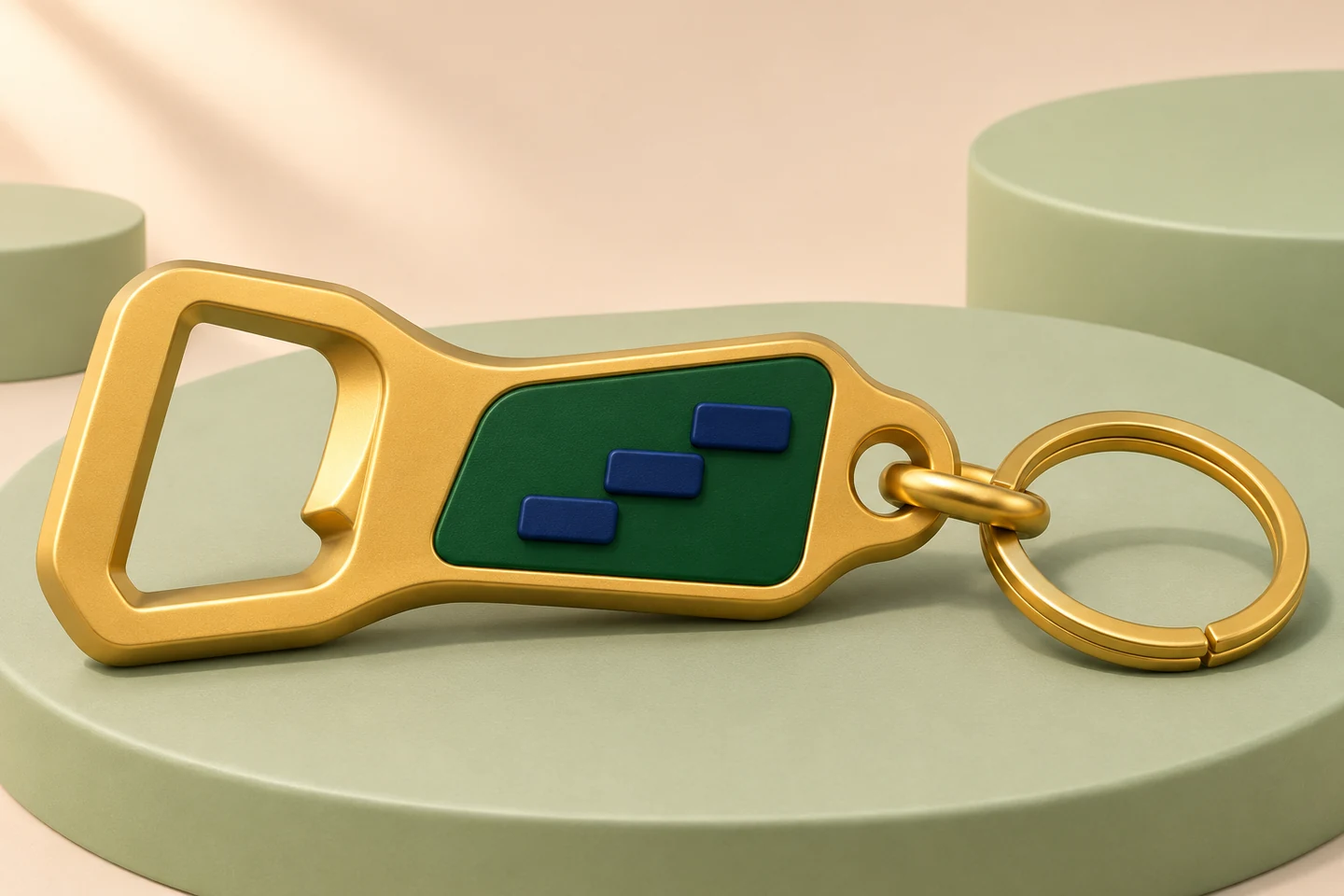
| Drawing Zone | Project-Specific Decision To Record |
|---|---|
| Working Opening | Actual proposed contact geometry and finished-edge reference; identify areas requiring functional review. |
| Grip Area | Intended handling space and surfaces; record observations on the actual complete assembly. |
| Connection Area | Hanging point, connector and ring positions, including interference observed during the agreed review. |
| Brand Panel | Authorised logo and colour boundaries outside the agreed functional restrictions. |
| Reverse And Edges | Requested detail, finish and contact surfaces linked to the complete sample revision. |
Record an undecorated area only where the project design requires it. Confirm its boundary instead of treating a diagram as permission to remove or add coating. The actual material, surface route and completed sample remain subject to the agreed project review.
Agree The Review Before Running It
Have the buyer and appropriate technical reviewer agree the method for the actual capped-bottle references. Identify the responsible person, sample condition and observations required. Do not replace that agreement with an informal consumer opening demonstration or an invented standard test.
Define what constitutes an acceptable observation for the intended combination. Include working engagement, handling access and complete-assembly clearance. Define stop conditions for slipping, damage or an unresolved condition before anyone begins the review.
Record whether the samples represent the finished production construction. If a development part differs in material, edge condition or assembly, state that limitation. The reviewer must decide what it can establish and which questions still require a representative sample.
Identify each capped-bottle sample used during the review. Preserve its package reference and initial condition in the record. An observation on one sample must remain distinguishable from a result obtained after the bottle or closure reference changed.
Do not prescribe universal force, repeated-cycle counts or glass acceptance limits through this guide. Any such requirement needs an appropriate method and authority for the actual project. A favourable observed opening alone cannot support unrelated strength or lifetime claims.
Observe The Working Body With Its Ring
Review the complete supplied assembly, including the actual connector and ring. Record any movement into the intended handling space or working region. Keep that observation separate from whether the body engages the agreed cap reference.
Identify the body and assembly sample in each photograph or video. Show enough of the complete item to explain the contact being reviewed. A cropped logo photograph cannot establish where the connection sits during the functional assessment.
Record the outcome in descriptive terms under the agreed method. Note loss of engagement, restricted access or a changed edge condition where observed. Do not average a slipping result and an acceptable result into a general pass.
Stop and hold a sample when slipping, damage or an unresolved condition appears. Retain the affected evidence for the responsible reviewer. A promotional deadline or an attractive brand finish does not authorise a safety exception or further unsupported use.
If the ring interferes, record where and under which assembly reference it occurs. Do not remove it simply to obtain a passing result for the complete product. A loose-body result answers a different question and must remain labelled as such.
Fill The Revision And Bottle Matrix
Consider a hypothetical beverage programme requiring 1,200 complete opener keychains. Eight hundred are allocated to bottle group B1 and four hundred to B2. These are fictional order allocations, not sample counts, measured factory results or standard commercial quantities.
The buyer receives body revision O1 under assembly A1, with its identified connector and ring. The agreed review uses actual capped-bottle references B1-S1 and B2-S1. Both the bottle and cap identities remain attached to their individual observations.
O1/A1 completes the defined review on B1-S1 with accepted engagement, handling and ring-clearance observations. On B2-S1, the working contact loses engagement. The reviewer stops the trial and records ring movement into the handling area as a separate observation.
The team has not established whether those two B2 observations share one cause. It requests a documented design response and another sample. No one converts the B2 result into a pass by disregarding the ring or omitting the slipping observation.

| Illustrative Combination | Observation And Order Decision |
|---|---|
| O1 / A1 / B1-S1 | Defined review accepted on the named bottle/cap reference. Release the 800-unit B1 allocation only. |
| O1 / A1 / B2-S1 | Loss of engagement and separate handling interference recorded. Stop; hold the 400-unit B2 allocation. |
| Proposed O2 / A2 / B2-S1 | Changed body and assembly proposal awaits representative review. No result; the same 400-unit allocation remains held. |
The record releases 800 units and holds 400, preserving the 1,200-unit requirement. The proposed O2/A2 sample does not add another 400 units. It represents a possible way to resolve the existing held allocation after feasibility and review.
Approval of O1/A1 for B1 remains limited to the recorded combination and agreed requirements. It does not declare B2 inherently unsuitable for every opener. It also does not establish universal suitability for other bottles sold under the same beverage brand.
Review The Proposed Change Without Losing Identity
Ask the supplier to describe its proposed response to each recorded observation. Identify changed working geometry, handling space or connection components separately. Confirm feasibility before treating any proposal as an available production construction.
Where practical, isolate a change so the next comparison can answer a specific question. If several features must change together, state that limitation. A successful revised assembly may support its complete approval without proving which individual change resolved the issue.
Give O2 its own body drawing and physical sample identity. Give A2 the corresponding connector and ring references. A familiar logo or common finish name must not conceal a changed functional body inside the revised sample package.
Repeat the relevant review against B2’s actual capped-bottle reference under the agreed method. Record the new outcome and the unresolved questions. Do not write that a proposed opening or connector fixes the problem before the representative sample has been assessed.
If O2/A2 is intended to replace O1/A1 across both allocations, include B1 in the affected review. The earlier B1 result belongs to O1/A1. A common production preference does not transfer that physical evidence to the changed construction.
Make Partial Release Operational
Write the released body, assembly and capped-bottle references together on the order decision. Identify the 800-unit B1 line and its evidence. Keep the 400-unit B2 line visibly restricted while its revised sample remains pending.
Agree whether the supplier may prepare anything for the held line before final approval. Identify that limited work and its commercial consequences separately. Permission to develop a revised sample should not become permission to manufacture and dispatch the entire unresolved balance.
If the same physical version is stocked for several programmes, identify where this approval applies. Receiving and distribution need the covered bottle reference alongside the product identity. A generic approved-opener label would conceal the condition on which the release depends.
Keep held or stopped samples outside approved reference stock. Preserve their IDs and observations for the technical review. They should not return to the sample drawer as apparently equivalent examples of an accepted construction.
Count complete assemblies when reconciling the released quantity. Spare rings, loose bodies and development samples do not satisfy that line by themselves. The unit released for distribution must match the complete item assessed against the intended capped bottle.
Define The Reconfirmation Triggers
Keep a short trigger list beside the signed matrix. Reopen the relevant decision when the working edge, body profile, finishing route or actual contact condition changes. Ask the reviewer which observations the change affects before carrying the result forward.
Include changed connectors, rings or hanging-point positions where they alter functional or handling clearance. Keep joint durability questions in the separate keychain assembly durability guide. A secure joint alone does not establish engagement with the intended cap.
A changed bottle or crown-cap reference also needs a coverage decision. Obtain actual representative references and compare them with the approved matrix. Do not extend approval solely because a purchasing description still says crown cap.
A logo revision needs review if it changes the body outline, surface or restricted areas. A purely administrative artwork change may have a narrower effect. Record the responsible reviewer’s conclusion rather than assuming either that every change is harmless or that every change requires identical work.
Keep overall carrying dimensions in your keychain dimensional specification. The functional matrix here records the working contact and complete assembly. Linking those records keeps a changed overall size from bypassing the cap-fit decision.
Send The Functional Sample Handoff
Send the supplier the body drawing, complete assembly reference and actual capped-bottle coverage list together. Attach the signed observations and unresolved actions. Identify which physical samples travel with the package and which references the buyer retains.
Ask the receiving team to compare the finished production version with the accepted complete sample. Record any changed opening, edge condition, connector or ring. A front logo match cannot establish that the functional revision stayed unchanged.
For a programme that chooses a decorative alternative, specify custom logo keychains as a separate product decision. Do not issue them as supposedly approved openers. Their role is different when the business brief no longer requires a bottle-opening function.
Likewise, company logo enamel pins can serve a separate wearable identity brief. They do not resolve the held opener combination. Keep their product approvals and allocation outside the functional opener’s release record.
Retain the final capped-bottle matrix with the approved samples and order versions. It should show what purchasing may release, what remains held and what evidence is required next. That usable decision record is the output, rather than a general claim that the logo item works.
Frequently Asked Questions
Can A Printed Mockup Approve The Functional Opening?
Use it to discuss layout and the relationship between brand and functional areas. Record its limitations. A different material or unfinished geometry cannot automatically establish the result for the finished supplied assembly against the actual capped bottle.
What If We Can Obtain Only A Loose Cap?
Identify which limited questions the responsible reviewer believes it can answer. Keep the actual capped-bottle review pending where required. Do not describe a substitute reference as the intended finished package without documenting and approving that distinction.
Can We Mix Approved Colour Versions In One Carton?
Agree their separate identities and packing quantities first. Check whether each version shares the approved functional body, finish scope and assembly. A common carton is a distribution choice; it does not extend one version’s functional approval to a changed construction.
Who Decides Whether A Stopped Trial Can Resume?
Use the responsible technical reviewer and decision owner named in the agreed plan. Preserve the stopped result and proposed corrective evidence. Resume only after the documented review resolves slipping, damage or the unknown condition, regardless of commercial urgency.
Final Thoughts
Bring your actual capped-bottle references and complete sample when discussing bottle opener keychains. Release only the documented combinations, and keep unresolved functional results on hold until appropriate evidence supports the next decision.