
Check Custom Cufflinks As A Complete Working Pair
Your cufflink faces match the artwork, but the complete pair still needs approval. Each back must work on its intended cuff.
Compare both wearing positions and the packed pair. Record which shirt constructions and pair versions your bulk release actually covers.
Define The Complete Pair
Begin with the delivered unit your programme requires. Write whether one order unit means a complete pair or one individual cufflink. Include both posts and both working backs in the physical sample reference.
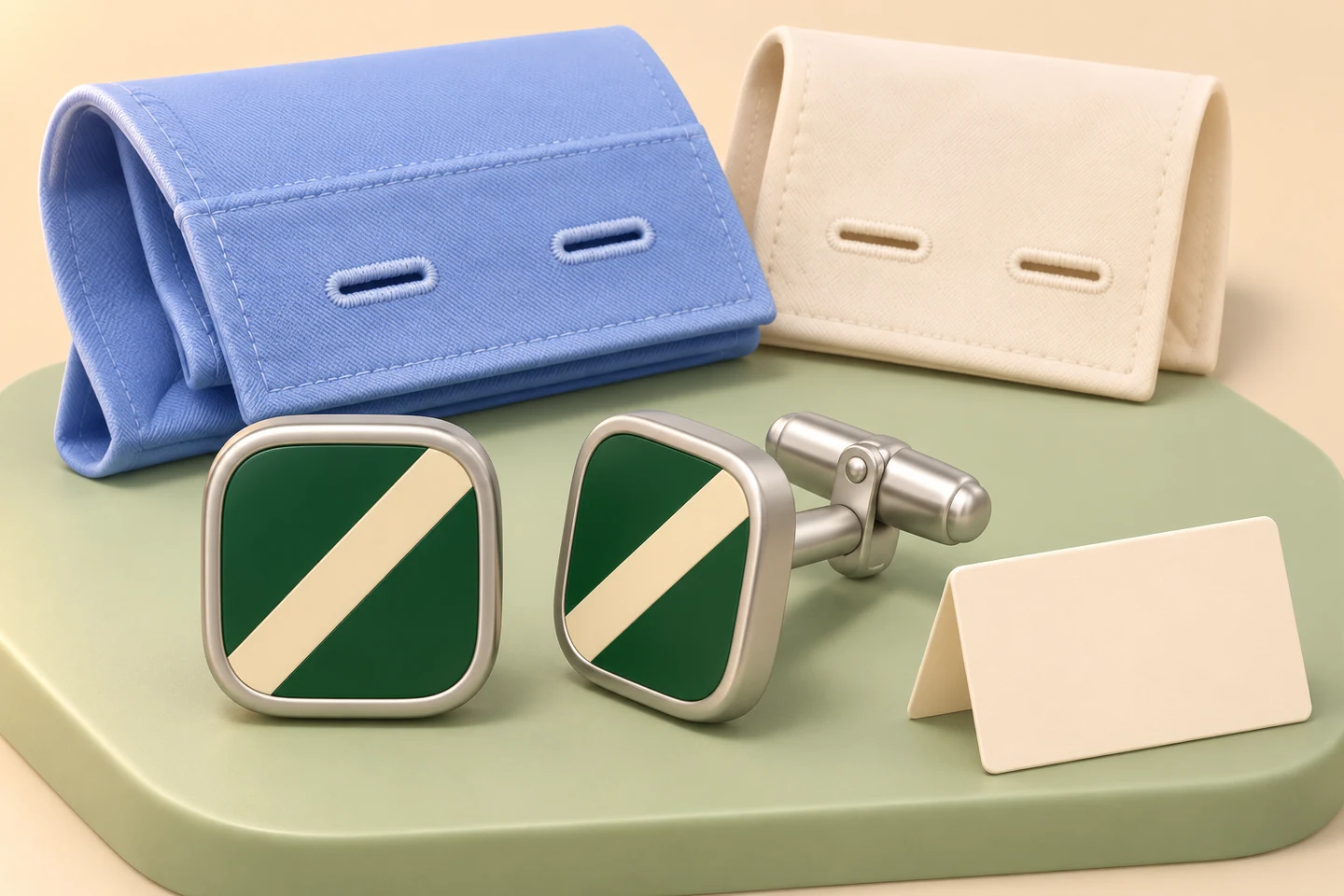
Our custom cufflinks reference shows two rounded-square faces with posts and moving crossbars. Review that assembled construction here. Another backing arrangement needs separate confirmation rather than approval borrowed from the illustrated pair.
Assign the sample pair an ID and distinguish its two members in the record. Use temporary tray positions or labelled photographs when permanent marks are unnecessary. The reviewer must be able to trace an observation to the same individual unit later.
State whether the pair contains interchangeable units or deliberately different members. Identical front artwork does not settle that question. The relationship between face, post and back may still need a defined orientation for each wearing position.
Keep a list of shirt styles that will use the pair. Corporate buyers, uniform teams and distributors should agree who supplies those shirts. A photograph of a generic cuff is useful context, but it cannot replace missing construction evidence.
Draw Both Wearing Positions
Put the left and right cuffs on the same approval sheet. Define those directions from the wearer’s perspective. Add a separate viewer reference so a photograph taken across a desk cannot silently reverse the intended reading direction.
Mark the top of each face and the direction of any lettering or directional symbol. Show the cuff in its normal wearing position. A pair displayed neatly inside a box may read differently when one sleeve turns away from the viewer.
Decide whether the brand requires identical artwork, mirrored geometry or two intentionally different faces. Obtain explicit brand approval before mirroring any logo. A geometrically balanced display is not permission to reverse a protected identity.
Show the post position and crossbar direction behind each face on the drawing. Link those reverse views to the corresponding fronts. This prevents a visually correct face proof from concealing an unresolved assembly relationship.
Keep the display arrangement separate from the wearing arrangement. You may choose a presentation layout that looks symmetrical while both faces remain identical. Record how the packer should orient them without suggesting that the actual cufflinks have become handed.
| Pair Definition Field | What The Approval Must Show |
|---|---|
| Order Unit | One complete pair: two assembled cufflinks, with the specified posts and working backs. |
| Face Relationship | Identical, mirrored or different; authorised artwork reference for each member. |
| Wearing Reference | Wearer-left and wearer-right cuffs; face top and intended reading direction. |
| Reverse Relationship | Post position and crossbar reference linked to each front, with any handed distinction stated. |
| Packing Reference | Pair member positions, retained orientation and version identification. |
If the brand artwork looks symmetrical, retain an orientation reference for the complete assembly anyway. The reverse may still define a preferred fitting direction. This is especially useful when a later artwork revision introduces lettering while the programme keeps the same backing concept.
Choose The Shirt Samples
Ask for the shirt constructions the programme will actually issue. Record the style, size and cuff version beside each sample. Include reinforcement, folded layers and lining wherever they form part of the fastening interface.
Identify the complete passage through the cuff, not just one visible opening. Review the layers in their intended folded arrangement. Record which side receives the face and where the moving back rests after fastening.
Do not group shirts solely because their fabric colours match. A changed cuff fold or reinforced opening can alter the available space. Ask the garment owner which constructions a sample represents and which need their own trial.
Keep actual cuff dimensions and any requested limits on the controlled shirt or assembly drawing. Record units and the measurement locations. The purchasing record should identify those references without inventing a universal cuff thickness or post length.
If a supplier receives only a removable cuff swatch, state what it cannot reproduce. Sleeve access and surrounding seams may still require a complete shirt. Keep that later review visible instead of treating a limited sample as unrestricted approval.
Review Both Working Backs
Examine both complete cufflinks before fitting them. Compare each face, post and moving crossbar with its drawing. Record visible differences so an assembly discrepancy is not confused with a difficulty caused by the shirt.
Operate the actual crossbar through the positions needed for insertion and retention. Record whether it reaches the intended position without conflicting with the cuff. Do not infer a closure-force rating from how the sample feels in one person’s hand.
Fit each member to its assigned cuff and retain its identity during the review. Check access for opening and removing the back. A working left unit does not prove that the second unit was assembled or checked correctly.
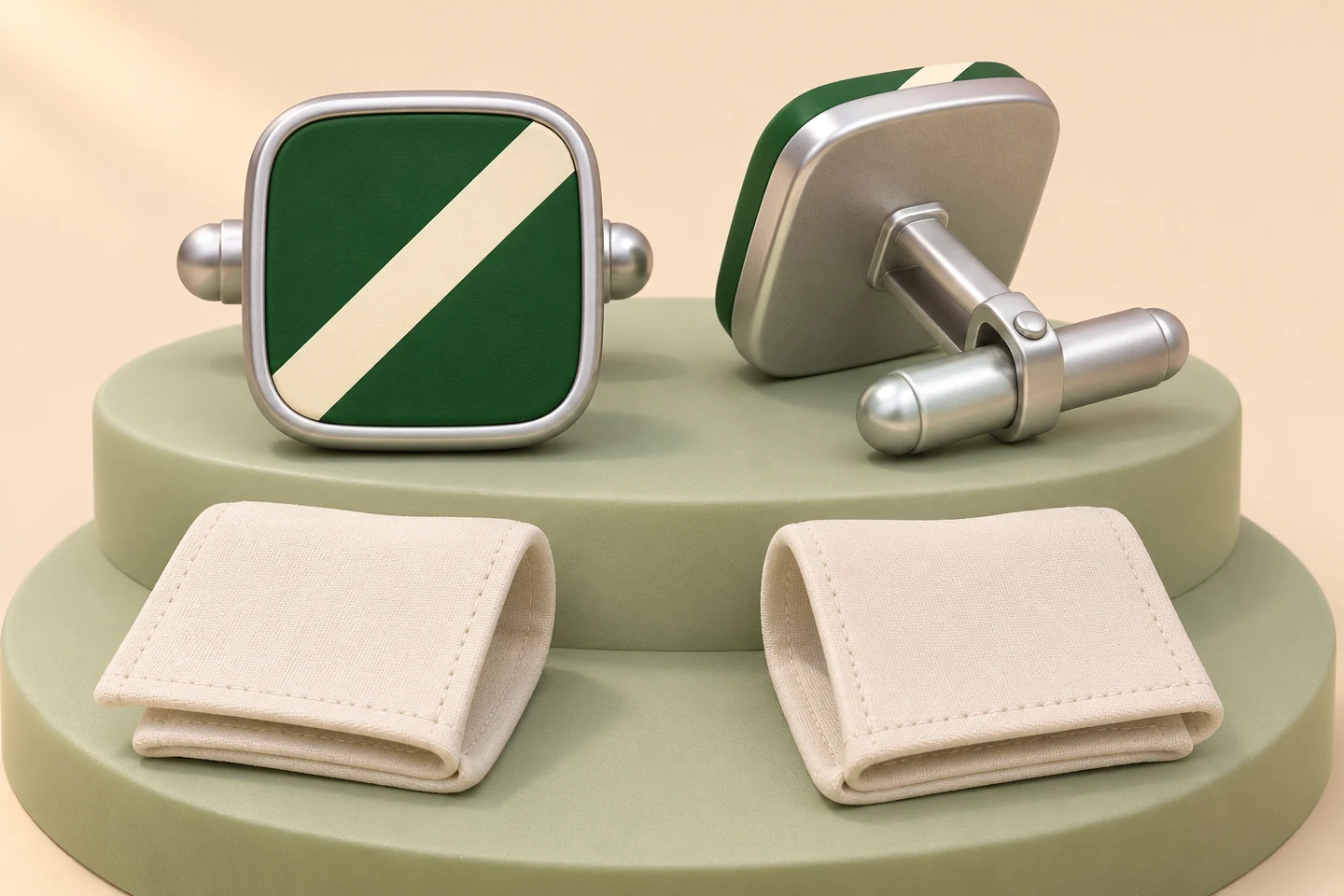
Look at the face and the reverse after fastening. Record unwanted tilt, displaced fabric, restricted movement or an incomplete retained position. Describe the observation and its location before proposing a change to the post or back.
THE/STUDIO’s custom cufflink page separates post options and packaging. It also presents order quantities in pairs. Those distinct choices support specifying the complete supplied unit, but establish no Green Frog Supply mechanism or performance rating.
Record A Comparable Pair Trial
Agree a short handling sequence with the programme owner before testing. Include insertion, fastening, normal cuff positioning and removal. State the actions and repetitions completed so another reviewer can repeat the comparison.
Let representative programme users handle the approved sample where practical. Record access difficulties without assuming every wearer has the same dexterity. Any accessibility requirement needs its own agreed brief and decision rather than a universal claim about easy operation.
Review the pair together on the shirt after checking each closure. Compare face direction, apparent position and the intended relationship between the sleeves. Keep close-ups and an overall wearing view under the same sample ID.
Use the same observation conditions when comparing proposed changes. Record the shirt construction and which pair member you used each time. Changing the shirt, backing and face arrangement together makes it difficult to identify what resolved a problem.
A brief fitting trial is evidence of the observed combination only. It does not qualify endurance, washing, corrosion resistance or retention under every activity. Define any additional test with its method, samples and acceptance criteria before relying on its result.
Record differing reviewer observations before deciding which construction to change. One person may operate the loose back successfully while another struggles on the fitted shirt. Repeat the disputed action on the same identified cuff rather than combining those different conditions into a pass.
Complete The Worked Approval Record
Consider a hypothetical uniform programme requiring 120 complete pairs. Eighty pairs are allocated to shirt C1 and forty to shirt C2. Both lines initially request pair version P1, containing two complete units under the same approved face revision.
The sample owner receives pair P1-S1 and records members A and B separately. Both have the intended face orientation on C1. On C2, member B’s back cannot reach its intended retained position through the actual folded cuff.
The team stops that C2 trial and retains the fitted sample for review. It does not describe the result as a missing logo approval. The unresolved question concerns the actual cuff and fastening combination, with the affected member identified.
| Illustrative Combination | Recorded Result And Release |
|---|---|
| P1-S1 With C1 | Members A and B fit, operate and read as approved during the agreed trial. Release 80 pairs for C1 only. |
| P1-S1 With C2 | Member B cannot reach the specified retained position. Hold the 40-pair C2 allocation pending a revised sample. |
| Proposed P2 With C2 | Backing or assembly proposal not yet approved. No result and no release until both complete members are reviewed. |
The release covers 80 pairs, equivalent to 160 individual cufflinks. The held line contains 40 pairs, equivalent to 80 individual cufflinks. Together they account for 120 pairs and 240 units, excluding separately ordered samples or replacements.
The buyer requests an identified proposal for C2 rather than extending the C1 approval. If a changed construction is proposed, it receives version P2. The supplier must confirm feasibility, and the revised pair must pass the defined C2 review before release.
Resolve Orientation And Fit Separately
Use different decision fields for brand direction and fastening fit. A pair can read correctly while one back remains unresolved. It can also fasten successfully while a directional logo faces the wrong way on one sleeve.
If orientation is wrong, compare the approved drawing with the actual front-to-reverse relationship. Establish whether the artwork, assembly or fitting instruction differs. Correct the responsible reference rather than casually rotating a logo file to suit one photograph.
If the cuff obstructs the back, review the complete space and movement required. Ask the shirt owner and cufflink supplier to compare possible changes. Do not promise that a longer post, smaller face or altered cuff will solve the problem before sampling.
When a proposed change affects both members, examine both again. If only one is handed, keep that distinction explicit in the new pair definition. A revised single unit should not be accepted merely because it looks similar beside the unchanged member.
Preserve approvals that still apply and identify those needing repeat review. A backing change may leave the authorised face artwork unchanged. It can still alter wearing position and packing fit, so the revised complete pair needs those affected checks.
Approve The Packed Pair
Use the actual approved pair in its intended presentation. Check that the pack retains two complete cufflinks without forcing their backs into an unintended position. Record the insertion and removal arrangement with both units identifiable.
Keep the pair definition visible on the packing instruction. If members are handed, show which belongs in each position and how the packer recognises it. Do not rely only on two similar face photographs when their backs differ.
Separate the packing arrangement from cosmetic acceptance. A box can hold the pair securely while displaying one face in the wrong direction. Approve both the protective arrangement and the intended presentation before the packed sample becomes the reference.
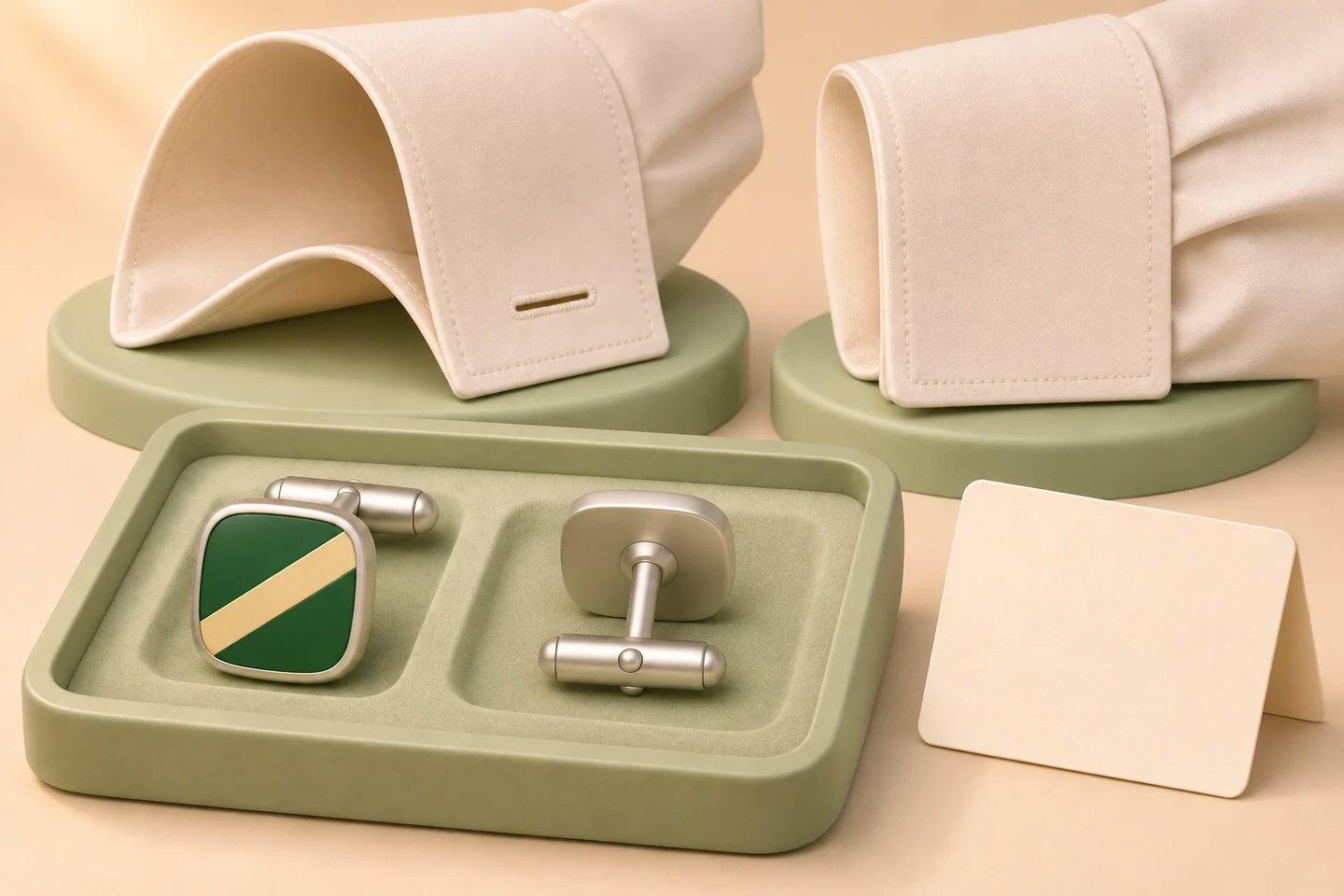
List included accessories explicitly and confirm who supplies them. A shirt used for sample fitting is not automatically part of the order. Likewise, a presentation box, insert or instruction card needs an agreed supply line rather than an assumption from an illustration.
Keep the pair version on inner packs and carton records. If the programme later adds P2, prevent one P1 member being combined with one P2 member. Count complete approved pairs first, then reconcile any separately identified individual replacements.
Specify the counting stage used by the packer and receiving team. Two complete units counted before pairing can still produce mixed or incomplete final packs. Reconcile the number of finished approved pair packs after matching, with individual replacements kept outside that count.
Keep The Programme Items Distinct
A corporate accessory programme may coordinate cufflinks with company logo enamel pins. Compare the brand artwork and intended appearance across those items. Their different fastening interfaces still require separate physical approvals.
For employee recognition pins, the programme may also have milestone variants or individual awards. Keep those quantities distinct from cufflink pairs. One recipient receiving both items does not turn their units or sample records into a common specification.
Our production proof signoff guide explains controlled artwork permissions. Apply that discipline to the face revisions. The additional evidence here is two assembled cufflinks working as a defined pair on the actual shirt construction.
Provide the programme’s issuing team with a photograph of the approved packed pair. Identify any shirt restriction alongside it. This helps prevent a familiar-looking accessory from being assigned to a cuff construction that remains outside its release.
Release A Defined Pair Version
Send purchasing a signed release identifying the pair version, face revisions and approved cuff constructions. Attach the member views and handling observations. State any unresolved allocation as a hold, with the next sample and decision owner named.
Send the supplier the same pair definition used by packing and receiving. Confirm quantities in pairs and provide the individual-unit equivalent for reconciliation. Keep additional individual replacements on separate lines with their member identity or interchangeability stated.
Compare the first packed production pairs with the retained complete sample. Check both members, their working backs and their presentation. A correct carton total cannot establish that the carton contains correctly matched pairs.
For repeat orders, flag any changed shirt, post, backing, face relationship or packing insert. Review the affected combination before carrying approval forward. The finished record should tell the next buyer exactly what was released and what evidence supported that decision.
If the programme uses more than one distributor, send the same current pair record to each. Identify who may approve a repacking change locally. A distributor should not replace the insert or mix residual pair versions without reviewing the effect on the delivered unit.
Frequently Asked Questions
Can We Buy One Replacement Cufflink For A Lost Member?
Confirm whether the approved units are interchangeable or handed, then identify the missing member. Match the complete construction and current pair version. If its appearance differs from the retained member, review the combined pair before issuing it as a replacement.
What If Our Shirt Supplier Cannot Send A Finished Sample Yet?
Record the missing construction and agree whether an interim cuff sample can answer any limited questions. Keep complete-shirt approval pending where it remains necessary. Do not describe the shirt as covered merely because its proposed fabric matches an earlier sample.
Can One Box Hold Different Approved Pair Versions?
Only use a shared insert after reviewing each complete version in it. Identify the covered pairs on the packing instruction. A common box size does not prove that different face profiles or working backs have the same retained position.
Should We Engrave Left And Right On The Cufflinks?
Use temporary sample labels unless the brand and product owners require permanent identification. Approve any permanent mark’s location and appearance on the complete unit. Do not add it through an informal packing instruction.
Final Thoughts
Bring the pair drawing, actual cuff samples and packing reference when discussing custom cufflinks. Release a defined complete pair for its reviewed shirts, with every unresolved member or cuff combination clearly held.