
How To Approve A Garment Trim Card For Metal Clothing Labels
Your approved metal label can reach the sewing floor with the wrong fabric or mounting instructions. The sample still looks familiar.
Use a garment trim card to connect those choices. Approve the actual combination before releasing it for your garment style.
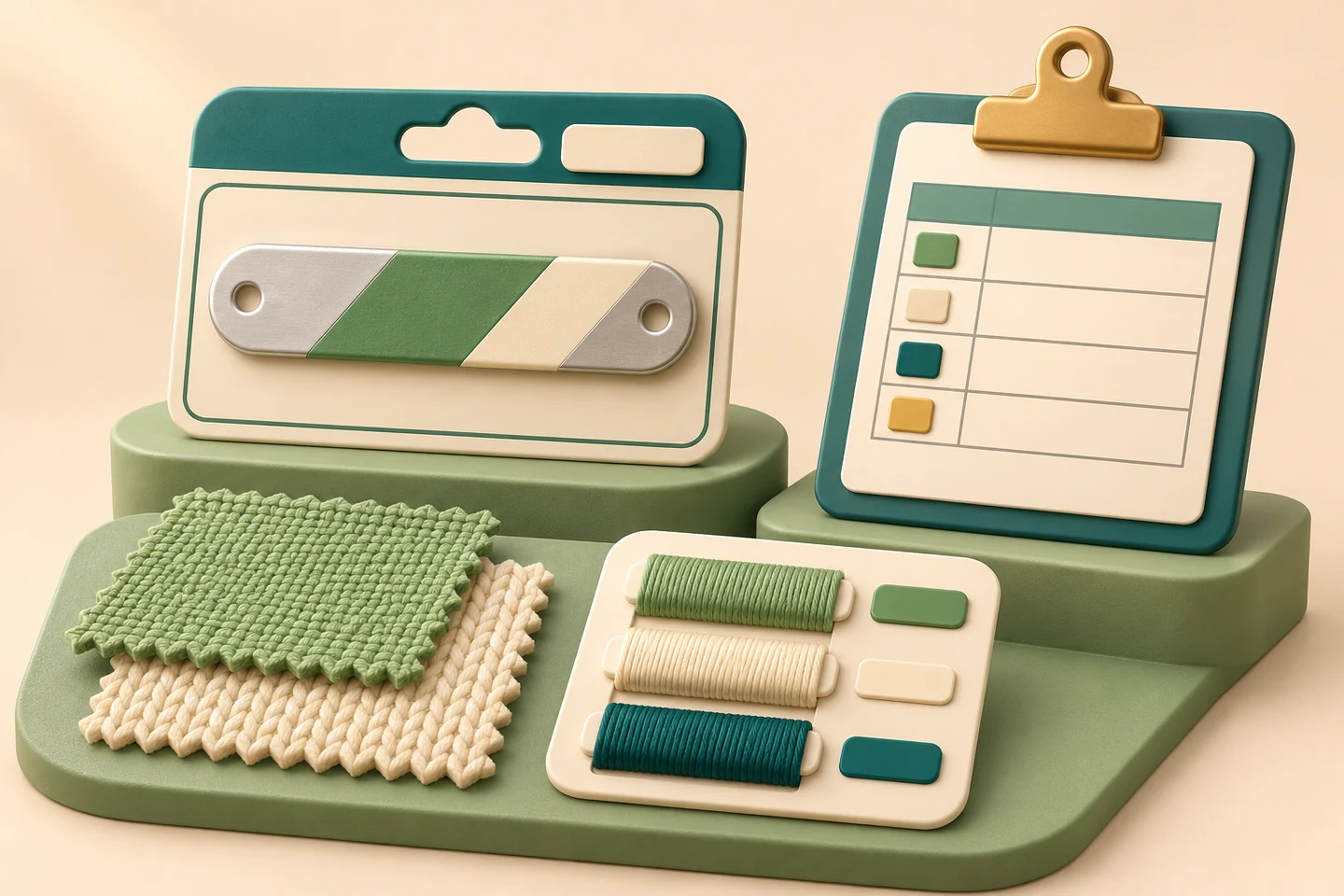
Define The Style And Approval Unit
Start with the garment style your factory will make. Identify its colourway, fabric construction and the position receiving the metal label. These details define the combination your approval needs to cover.
For custom metal clothing labels, review the brand face and sewing interface together. The published reference has two open sewing holes and a flat reverse. Your order still needs its own agreed dimensions, material and installation sample.
Give each physical label reference an identity that stays with its storage sleeve. Record the drawing revision and supplier item reference beside it. A finish description alone can leave several similar pieces eligible for the same card.
Write the approval unit as label reference plus garment construction plus installation reference. Include the supporting fabric or reinforcement when it affects mounting. A shared label can therefore have more than one installation approval.
Your approved card should tell receiving staff which material they can issue to which sewing job. Give the garment technologist a separate place to record unresolved installation work. This keeps a completed appearance review from silently releasing an unfinished assembly.
Connect The Physical Card And BOM
The Apparel Search trim card glossary describes physical trim samples with supplier, colour and placement references. It distinguishes that visual record from the written BOM. Link both references so purchasing and production identify the same component.
Find the metal label line in your bill of materials. Check its supplier item, revision, quantity per garment and colour or finish reference. Put the same identifiers on the card beside the actual label.
Keep purchase quantities on the order and usage quantities on the BOM. One label per garment does not define spare pieces or sampling allowances. Give those quantities their own approved order lines or instructions.
Identify the metal label separately from any thread, support patch or other mounting material. Assign each component to its responsible source. The garment factory needs to know which items arrive together and which it must prepare.
If the garment also uses metal zipper pulls, give them separate card positions. Cross-reference the pull and slider approval for that assembly. Its approved connection does not establish the label’s sewing arrangement.
Record who resolves a mismatch between the card and BOM. Stop that component’s issue while the responsible buyer checks both originals. Update the incorrect reference before the factory receives another copy.
Record The Label And Placement
Attach a representative actual label securely while keeping its reverse accessible. Use a labelled pocket or removable mounting when adhesive would hide important features. Protect the face so repeated handling does not change the reference.
Identify the approved front and the direction considered upright. Photograph both faces beside the sample ID. A clear reverse reference helps the garment factory recognise the intended contact surface and sewing holes.
Mark placement from a repeatable garment reference, such as a defined seam or pattern point. State which garment size the placement drawing represents. Give grading or size-specific placement instructions when the same position cannot simply carry across sizes.
Keep placement measurements on the controlled drawing, with units and any agreed tolerance. The trim card should identify that drawing and its revision. A photograph supports orientation but can distort distances and conceal fabric tension.
Review how the label sits when the garment hangs naturally. Look at its relationship with seams, pockets, folds and other visible branding. An attractive loose arrangement can still place the metal across a moving fold.
Describe what the worker should see after installation from the outside and inside. Include any deliberately hidden stitches or visible reverse construction. Leave a marked sample for interpretation when written placement language is ambiguous.
Approve The Fabric And Installation Combination
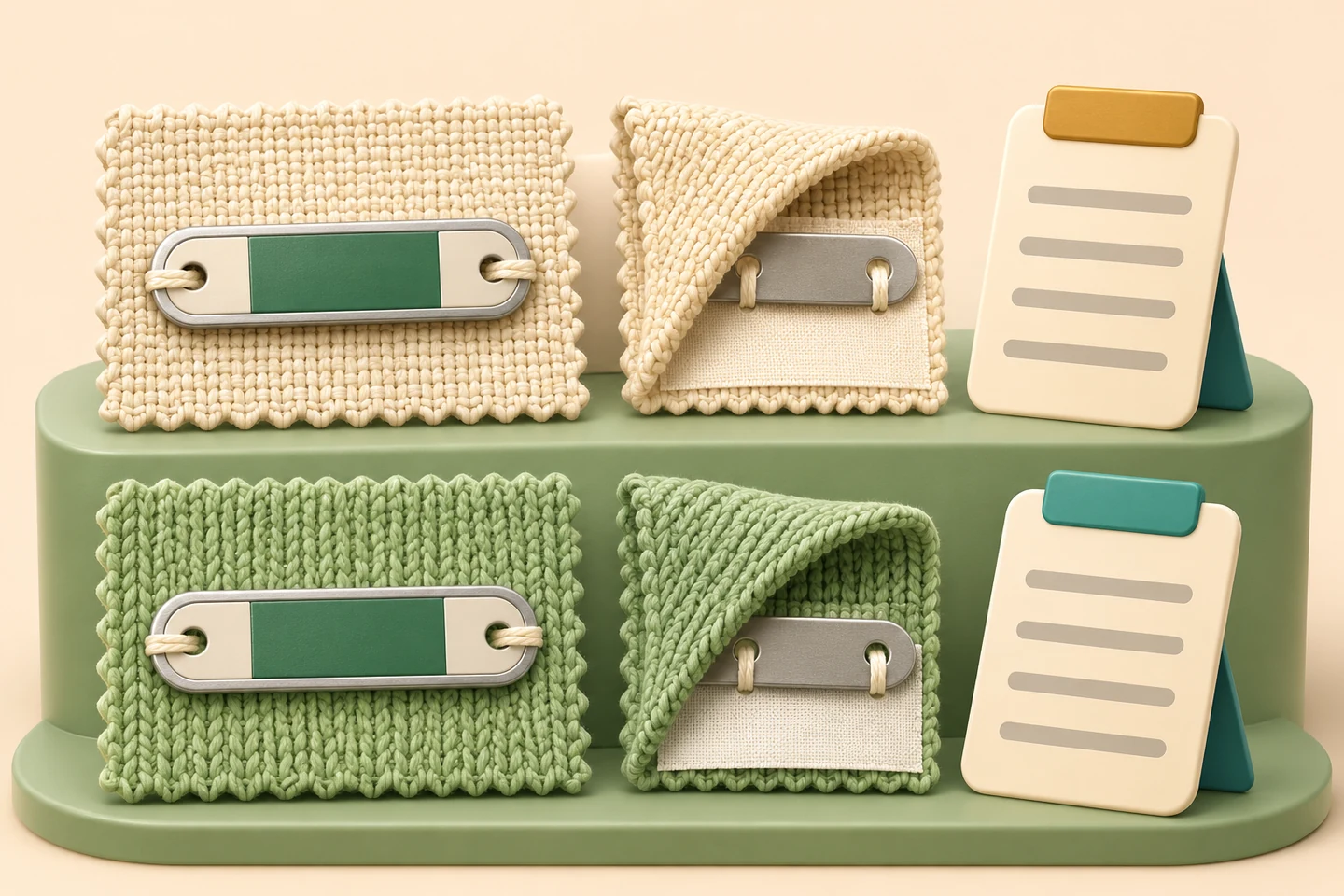
Use the actual fabric and layer arrangement where possible. Identify the fabric supplier reference, colour and construction beside the installed sample. Record lining, support patches and seam allowances that affect the reverse.
Have the garment factory propose and record its sewing arrangement. Include the thread reference, stitch route and any agreed supporting material. Confirm who owns that installation instruction before approving the card.
Check whether sewing passes through both label holes without unwanted contact against the metal edge. Examine fabric distortion around the attachment. Record observations with the installed sample ID so revisions can be compared.
Review the reverse with the garment in its intended construction. Look for exposed ends, trapped lining, bulky thread groups or contact with nearby hardware. Record what requires adjustment before repeating the installation.
Coats’ soft and secure seams bulletin relates seam feel to thread and fabric choices. It also describes differences between fabric directions. Use that context to request representative sewn samples, with your garment technologist defining the installation.
Move and handle the sample in the ways your garment review requires. Record the condition and observations without inventing a universal test threshold. Ask for another sample if a proposed support or sewing change alters the contact arrangement.
If you use a representative fabric, record why it represents the intended garment construction. Name any differences still awaiting review. Confirm the actual production fabric before extending approval where those differences could affect mounting.
For example, a darker colourway may also use a different fabric supplier or backing. Check the material references before sharing an installation decision. The shared metal label alone does not establish that both garment constructions behave alike.
Fill A Style-Specific Trim Card
The following hypothetical order uses one metal label on two garment constructions. Every reference and quantity belongs only to this illustration. The example shows how one component can receive different installation decisions.
Style J41 is a woven overshirt with a supported pocket panel. Style K42 is a knitted cardigan using the same label drawing. The buyer assigns each combination a separate card so production cannot confuse their status.
| Card Entry | Illustrative Completed Record |
|---|---|
| Style And BOM | J41, olive colourway, BOM revision C, metal label line 14, one label per garment. |
| Label Identity | Supplier item ML-07, drawing D, finish reference FIN-04, physical label sample L-21. |
| Fabric Assembly | Woven fabric W-18, olive, with support patch S-03 and installed sample J41-I02. |
| Placement | Pocket-panel position drawing P-11 revision B, front upright as marked; reverse photo J41-R02. |
| Installation | Garment factory instruction SEW-06 revision B, thread TH-08, both holes used; supplier supplies loose labels. |
| Review | Buyer appearance review accepted; technologist accepts supported installation against sample J41-I02. |
| Linked Evidence | Garment evaluation GE-17 covers this recorded construction and agreed care conditions. |
| Release And Receipt | Card TC-J41-03 approved for the J41 order only; factory copy FC-02 acknowledged by production lead. |
For K42, the buyer records knitted fabric K-09 and installed sample K42-I01. The fabric gathers around the holes during handling. That installation remains open while the technologist reviews a revised support arrangement.
Write the K42 decision explicitly as sample development only. Keep its label material identifiable while preventing issue to that sewing order. The accepted J41 card can proceed independently when its other order requirements are complete.
Turn Observations Into Release Decisions
Treat the two card decisions as separate production instructions. The buyer can authorise the woven construction without accepting the knitted installation. Tell the stockroom which garment job may receive the shared label material.
Suppose the hypothetical order includes 600 J41 garments and 400 K42 garments. Both need one label each. Issuing 600 labels to J41 does not authorise the remaining 400 for K42.
| Observed Combination | Illustrative Decision And Required Next Evidence |
|---|---|
| J41 With Approved Support | Permit issue for the named 600-garment job after normal material and order checks; retain installed sample J41-I02. |
| K42 Original Installation | Hold installation for the 400-garment job; request a new supported sample and compare distortion and reverse contact. |
| K42 Revised Sample | Keep development status until the technologist reviews the complete new construction and relevant evaluation evidence. |
| Unidentified Loose Label | Quarantine the material identity for review; compare its drawing, supplier reference and finish with the controlled original. |
If the revised K42 arrangement is accepted, identify its new installed sample and card revision. Record which earlier observation it resolves. Give the stockroom a dated release for the exact K42 job and remaining quantity.
A verbal instruction to use the same label leaves the unresolved construction invisible. Issue the approval with both the component and garment identifiers. Ask the production lead to repeat those references in the receipt record.
Link Evaluation Evidence To The Card
List the evaluations your actual garment brief requires. Record their conditions, responsible organisation, specimen identity and report reference. Keep the result tied to the fabric, label and installation that were evaluated.
For care evaluation, the garment team must establish the applicable conditions and acceptance criteria. Identify whether the submitted specimen included the actual support and lining. Leave the card’s performance status open when that connection is missing.
A visual approval only confirms the reviewed appearance and placement. A separate evaluation record supports any approved care or handling claim. Write both outcomes on the card with their distinct references and responsible reviewers.
If the project also contains custom logo charm components, identify their assembly separately. A hanging component may contact a different area or move differently. Its card needs the actual connector and delivered state recorded alongside its own evidence.
Ask Green Frog Supply which component records and sample arrangements can be supplied for your order. Agree that scope before scheduling evaluations. Keep garment sewing and finished-garment assessment responsibilities visible between the brand, component supplier and factory.
Hand Over The Card And First Installed Piece

Send the controlled card, BOM revision, placement drawing and installation instruction as one named handoff package. Identify the physical reference travelling with it. Keep a record of which organisation holds each reference copy.
Have the garment factory acknowledge the exact revisions before issuing material. Ask it to identify any different reference already on the sewing floor. Resolve that difference while the affected job remains stopped.
- Match the received card number to the garment job and current BOM revision.
- Read the actual label, fabric, support and installed-sample identifiers back to the buyer.
- Confirm which combinations are approved, open for development or held from production.
- Identify the first installed production piece and the person comparing it with the approved construction.
- Record any difference before extending the installation to the remaining garment quantity.
The first installed production piece checks that the factory understood the handoff. Compare its placement, orientation, fabric support and reverse with the accepted sample. Record the job reference and outcome on the factory receipt section.
For a different trim supplier decision, use the apparel zipper pull supplier guide. Return here for the physical card and garment handoff. Supplier selection and installed-style approval need different records.
For the hypothetical J41 job, the factory records the first installed production piece as J41-F01. It compares that piece with J41-I02. Both references include woven fabric W-18, support S-03 and the same label revision.
| Factory Receipt Field | Illustrative Completed Handoff |
|---|---|
| References Received | Card TC-J41-03, BOM C, drawing D, placement P-11 B and installation SEW-06 B received together. |
| Physical Reference | Installed sample J41-I02 in sleeve REF-09; factory lead confirms both front and reverse are accessible. |
| Job And Quantity | J41 olive overshirt job, 600 garments; stockroom instructed to issue 600 identified ML-07 labels to this job. |
| First Installed Piece | J41-F01 matches the approved orientation and support arrangement; technologist records the comparison against J41-I02. |
| Unreleased Scope | K42 remains open for installation development; its 400 planned labels remain identified and unissued to sewing. |
| Factory Reply | Named factory production lead acknowledges the references and quantity-specific status; buyer files the receipt with the card. |
This receipt gives purchasing a direct check on what production understood. Compare its references with the package you sent. Resolve a different support code or missing physical sleeve before treating the handoff as complete.
If several factories share the order, give each its own receipt reference and controlled sample arrangement. Record the quantity assigned to each location. A signed card at one factory does not tell another location which working copy it received.
Keep the label’s inspected surfaces visible when making reference copies. Mounting tape across a hole can conceal the sewing route. Use an additional protected loose reference when the installed garment prevents useful inspection of the reverse.
Maintain A Usable Physical Reference
Check the reference before each new production issue. Look for a missing label, damaged finish, detached swatch or illegible identification. Replace a compromised sample through the named approval owner and record the replacement identity.
A new delivery with the same finish name still needs material identification and agreed receiving checks. Keep the supplier lot linked to the approved component reference. Escalate a visible or structural difference instead of adding it silently to the card.
When a fabric or mounting arrangement changes, identify the affected garment combinations. Reopen the specific installation decision and relevant evaluations. Leave unrelated approved combinations available if their scope remains supported.
Withdraw superseded working copies once the replacement is acknowledged. Retain their identities in the approval history so earlier garments remain traceable. Your useful output is a card that tells the next worker exactly which combination can be made.
Frequently Asked Questions
Can A Digital Card Replace The Physical Label?
Use the digital card to distribute identifiers, drawings and photographs. Keep a controlled physical reference available for characteristics the images cannot establish. Record where the factory can obtain that reference before approving its working copy.
Who Owns Approval When The Brand And Factory Disagree?
Name the decision owner in your purchase and garment development instructions. Record both observations against the same installed sample. Keep the disputed combination open until the named owner resolves it with the responsible technical reviewer.
Can Several Colours Share One Card?
They can share a document when every colourway and physical reference remains clearly identifiable. Give each installation scope its own status and evidence references. Separate cards help when one colourway remains open while another enters production.
Final Thoughts
Bring your garment style, fabric stack and proposed metal clothing label to sample review. Link the approved component to its installation and factory handoff. Release only the combinations your record actually supports.