
How To Budget A Bulk Custom Enamel Pin Order
Your brand team needs a budget for several pin designs before it approves artwork. A lower unit price can hide mounting or freight.
Price the same finished pins across quotes. Use the worksheet to compare the total per complete pin your team can distribute.
Define The Unit You Need To Budget
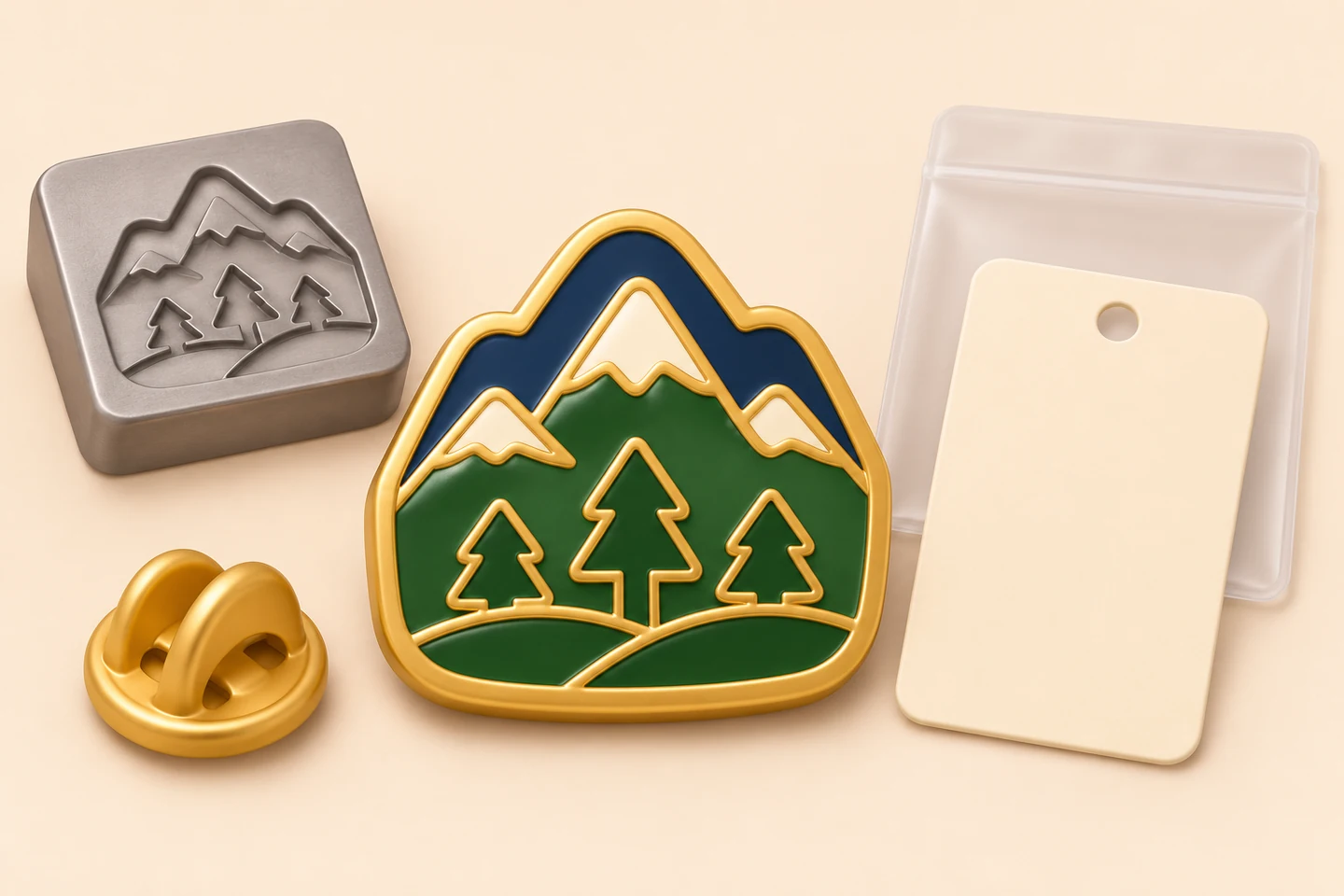
Start with the unit your staff will hand out, issue or sell. Write down the pin, attachment and any assembly the recipient must receive. Use the same description throughout your estimate and purchasing brief.
If a team wants two designs, count them separately. An estimate for 1,000 pins can mean one tooling setup or two independent runs. Each version can also require its own proof and packing labels.
Ask whether quantities refer to finished pieces or batches before you build a spreadsheet. A group asking for 400 two-pin sets needs 800 pins. Record how many sets must be ready at receiving.
Document the destination and whether the recipient can do any assembly. An event team may have no time to mount pins on cards. A warehouse may have staff to bundle pieces before dispatch.
Use that description when comparing the individual packing options. Count any internal assembly or sorting time in the same budget. Otherwise the cheaper quote can move work to your own team.
Separate Tooling, Repeat Costs And Delivery
Put one-time tooling and sample charges in their own lines. Ask which fees are credited against a production order and when. Keep them separate until a written quote confirms the treatment.
Repeat costs usually follow the number and configuration of finished units. Ask whether the quote includes the specified fastening, backing card, fitting, pack and carton grouping. Note any charge that scales by design instead.
Freight and receiving costs belong in a separate group. The amount may depend on shipment size, destination and agreed shipping terms. Ask which items are included and which must be estimated independently.
| Cost Group | What To Put On The Line | What To Confirm |
|---|---|---|
| Setup | Tooling, proof or paid sample | Which design or revision it covers |
| Repeat | Finished pin, backing and assembly | Whether packing and fittings are included |
| Receiving | Freight and buyer-side handling | Destination and responsibility for each cost |
Create a line for any assumption the supplier has not priced. Keep tax, freight or handling separate until responsibilities are clear. An empty line should be marked pending so the subtotal is useful.
Identify Which Design Choices Drive The Estimate
Changing the outside size can change both the metal body and what the artwork can hold. Give the target width and any maximum height. Ask the supplier to flag details that become difficult at that scale.
Break down the artwork into the outline, lettering, color regions and metal finish. A second color may affect filling work while a new outline can affect tooling. Ask what changes for your specific artwork.
Small lettering near a border is a good design-to-budget test. A wider pin may improve legibility but increase the material footprint. A shorter inscription may protect the mark at the original size.

Keep the feature that identifies your program and ask for any simplification as a separately priced alternative. Use the pin artwork guide to check the revised proof before brand approval.
If the finish is still open, ask for it as a separate alternative. Consult the custom pin manufacturing page for the project inputs. Keep the size and quantity constant across the options.
Test Quantities By Design And Version
Prepare a quantity matrix before asking about volume pricing. Show each design and color version, plus the number you need of each. Ask whether quoted breaks apply to the overall run or per design.
Consider an example order with 800 logo pins and 200 anniversary pins. If the anniversary design requires separate tooling, the smaller run carries that setup across fewer pieces. The overall thousand-piece figure hides this difference.
Ask whether alternate colors share the same metal outline, artwork and tooling. A change in enamel may keep some steps consistent while still requiring separate handling. The response should describe how each variant is priced.
Keep contingency units visible. If you need extras for late additions, include them in the requested quantity and mark the reason. Ask the supplier how shortages or excess units are reported before dispatch.
Model only the reorder volume you can justify. Future demand may change the mark, date or delivery location. Ask how a repeat order will be evaluated if those project details are revised.
Calculate The Cost Per Usable Pin
Use the same target quantity and receiving destination for each option. Add setup, finished goods and the charges you will pay separately. Divide the resulting total by the number of complete units you can use.
The following numbers are an illustration in budget units. Use the worked example to set up your planning sheet. Each option delivers 400 finished, usable pins to the same destination.
| Illustrative Cost | Option A | Option B |
|---|---|---|
| 400 Finished Pins | 480 | 540 |
| Tooling And Samples | 100 | 40 |
| Buyer Assembly | 80 | 0 |
| Freight Estimate | 40 | 40 |
| Total Budget | 700 | 620 |
| Cost Per Usable Pin | 1.75 | 1.55 |
Option A has a lower initial finished-goods line. Its assembly and setup increase the total in this example. Compare both estimates using the same finished unit and check that each amount has a written source.
Round only after summing the full estimate. Keep any expected spare stock out of your usable quantity if it has no planned distribution. That lets procurement see the cost of its actual program.
Give each budget line a source, an owner and a confirmed or estimated status. Replace provisional freight with a confirmed amount before approval. Date the total your team uses for the decision.
Budget For The Steps Before Production
Ask what a physical sample covers and how changes are charged. A tooling correction, new artwork and different plating can have different effects. Record the revision that the supplier is quoting.
A tight budget may leave room for only one full sample round. Review a proof at the intended size and confirm the required view of the reverse. Have the people approving branding and wear sign off together.
Ask which decisions can be made before tooling is prepared. Finishing choices may require a physical reference while the outline can often be reviewed on a proof. Write a review plan for those separate decisions.
Use the production quality guide to define what you will accept. Record any tolerances or sample checks you agree for that order. Identify who can authorize extra work if something changes.
Keep a separate row for the consequences of a late change. Request a written estimate before revising approved artwork or converting the pack. Confirm the charges for each revision.
Request Alternatives That Protect The Brief
Share a required option and one optional way to save. The required option should retain the quantity, identity and use your team has agreed. Ask suppliers to quote the same baseline before suggesting changes.
If the artwork has optional text, ask for a version with the full mark and a simpler proof. If assembly is flexible, ask how a loose and mounted option are supplied. Confirm who will do any omitted work.
Price changes one at a time where possible. A smaller pin with different backing and packing gives you little evidence about which decision saved money. Hold the other details steady when you compare options.
Check the distribution impact of removing a feature. If the pin still needs to reach recipients on a labeled card, an unmounted alternative creates a separate receiving task. Include that labor when modeling the saving.
Give your team a clear decision note. State the saving, its assumptions and any lost feature or added task. Keep the approved option linked to the final proof and packing specification.
Send A Quote Request Your Team Can Reconcile
Attach the current artwork and a table with quantities by version. Name the delivery country and the receiving configuration. Mention which details are fixed and which alternatives you want to see priced.
Ask for the terms of tooling, sampling, finished units, fitting, packing and transport in writing. Request separate prices for optional extras. Check the quote validity and agreed revision before taking it to approval.
- Name the final use and the complete receiving unit.
- List each design and version with the required quantity.
- Identify the preferred size, finish, fastening and packing.
- Request separate setup and repeating charges with any credits shown.
- Record the delivery basis and the unresolved lines before approval.
Send the same document to each supplier and retain their dated replies. Use the manufacturer comparison guide when you review responses. Return any quote that substitutes an unspecified option for a fixed requirement.
Carry the final prices, artwork and shipment assumptions into the purchase order. Ask the supplier to confirm the package of documents before production. Your buyer should be able to reconcile every line without guessing.
Frequently Asked Questions
Can We Use A Previous Unit Price For A New Artwork Revision?
Use it as an internal placeholder only. Ask whether the revised outline or attachment changes tooling, handling or the pack.
How Should We Handle A Tooling Credit?
Keep the charge and credit visible as separate lines. Confirm the order or quantity conditions in writing before subtracting the credit.
Should We Include Spare Pins In Cost Per Usable Unit?
State whether spare pieces have an assigned use. When they are contingency stock, show their quantity and cost separately from planned distribution.
Can We Ask For Both Packed And Loose Alternatives?
Yes, define the same pin and quantity for each. Add your own mounting and sorting costs before comparing the final totals.
What If The Reorder Quantity Is Uncertain?
Keep the initial estimate independent of future volume. Request a separate repeat-order scenario with the tooling assumptions explicitly stated.
Final Thoughts
Use your finished-unit budget to brief the team before artwork approval. Share your quantity matrix with Green Frog Supply for a project-specific review.